Personality
Personality is the characteristic patterns of feelings, thoughts, and behaviour of an individual that make them unique.
Etymology of Personality
The word personality is derived from the Latin word ‘Persona.’
Which means ‘Mask.’
Therefore, personality used to mean the outward appearance of a person. Later, it came to mean the real nature of man.
Definitions
According to Eysenck
“Personality is the sum-total of actual behaviour patterns of the organism.”According to Cattel
“Personality is that which permits predictions of what a person would to do in a given situation”
Nature of Personality
- Personality is dynamic; it changes with situations.
- Personality refers to both physical and psychological qualities of an individual.
- It is unique in the sense that no two individuals are the same in terms of personality.
- Personality is influenced by both heredity and environmental factors.
Personality = Heridity * Environment - Personality refers to the role a person portrays to the public.
- Personality is not developed spontaneously; it develops over time.
Types of Personality
- According to The Big Five Personality Traits
OCEAN
O = Openness
C = Conscientiousness
E = Extroverism
A = Agreableness
N = Neuroticism
- According to Carl Jung, personality theory :
i. Introvert
ii. Extrovert - According to Sheldon’s Personality Theory
i. Endomorphy
ii. Mesomorphy
iii. Ectomorphy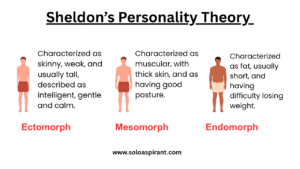
- According to Sigmund Freud, the mind is divided into three components that create personality.
i. Ego
ii. Super Ego
iii. ID
Determinants of Personality
There are two basic factors for any type of development of human type of development of a human heredity, and the other is environment.
Personality is not the sum, but the product of the influence of Heredity and Environment.
Personality = Heredity * Environment
Heredity is the process by which the biological characteristics, such as physical and mental qualities inherited by the child from offspring parents.
The following are the determinants of personality:
- Biological Determinants
- Environmental
- Psychological
Biological Determinants:
- Physical or Somatic Structure – A child is born from the union of parents; the child receives 23 chromosomes from his father and 23 chromosomes from his mother’s ovum.
There are many genes in each chromosome of the total 46 chromosomes. Whether a child becomes weak, tall, short, strong, dark or fair, all depends on genes. - Body Chemistry or Chemique – Secretion of hormones from endocrine glands (ductless glands) affects the personality of a person to a greater extent. Oversecretion and underfunction of these glands affect the individual’s personality.
- Thyroid gland – oversecretion of these fluids makes the person excitable, restless, upset, and irritable.
Undersecretion of these fluids makes the person slow, lazy, sleepy, dependent, and sluggish. - Parathyroid Gland – An oversecretion of this gland tends to slow down the person.
Undersecretion lowers the supply of calcium in the bloodstream and makes the person more excitable. - Adrenal glands – The secretion of these glands is called adrenaline, which is a powerful chemical for stimulating the release of blood sugar from the liver to provide energy.
- Pituitary gland – These are also known as master glands. Oversecretion of these glands causes gigantism, and undersecretion causes dwarfism.
- Thymus and Pineal glands – The Thymus is involved in growth and sexual development. The pineal gland gives off a secretion that influences body growth and sexual development.
Environmental Factors:
Environmental factors also influence the personality of an individual.
The following are the environmental factors that determine the personality of an individual –
- Cultural and Traditions – The culture of a society means the methods of living and eating habits of the people of the society. Children of different cultures are influenced by certain laws or rules caused by different religions, caste, community, race, etc.
- Family -The family environment plays an important and fundamental role in building one’s personality.
- Society
- School and Education
- Friends and peer groups
Psychological:
- Intelligence
- Motivation
- Attitudes
- Values and Beliefs
- Emotions
- Perception
- Learning and Experiences
- Interests
These are factors that influence an individual’s personality, how they think, how they feel, and how they behave.

Hi, I’m Amit Kumar — the author of SoloAspirant.
I am a part-time blogger and tutor with a background in Physics and a B.Ed. Through this platform, I share study materials, notes, and PYQ PDFs curated to help aspirants prepare effectively for teaching and competitive exams.