Introduction
Ivan Illich Pavlov, a Russian Physiologist, proposed the classical conditioning theory of learning, a Russian Physiologist. He was awarded the Nobel Prize for “Physiology of Digestion” in 1904.
Also, awarded the Nobel Prize for the theory of “Conditioned Response.”
This is also called “Response Theory.“
Conditioning = The process of modifying one’s behaviour through some preparation or training.
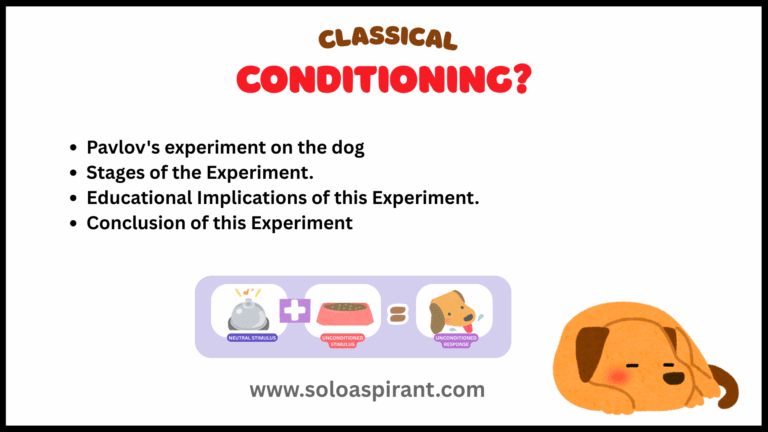
Pavlov’s experiment on the dog
He proposed a theory through the experiment that conditions can modify human or animal behaviour.
- Stimulus – An Object which is not responsible for any desired response
- Neutral Stimulus – An object that is not responsible for any desired response.
Eg – The ringing bell has nothing to do with the dog - Unconditioned Stimulus – Stimulus which doesnot required conditioning.
Eg – The dog’s natural response to food is an unconditioned stimulus. - Unconditioned Response – The behaviour that doesn’t require any practice or training.
Eg- Salivation is an Unconditioned Response by the dog seeing food. - Conditioned Response – The behaviour or Stimulus which occur due to a conditioned response.
Three Stages of this Experiment
Stage – I [Before Conditioning]
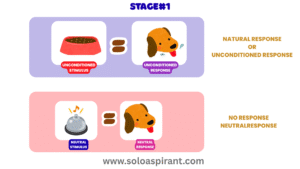
- Before the conditioning – When the food is kept near the dog, it starts salivation, which is a natural response of a dog after seeing food.
The food is an unconditioned stimulus or a natural stimulus. - The Dog does’not care about the bell, when the bell rang – Here, the bell is a Neutral Stimulus and the Behaviour of the dog to the Bell is a Neutral Response (No Response).
Stage – I [During Conditioning]
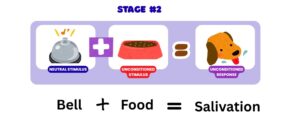
- The Dog presented with food every time after ringing the bell, which it salivates on seeing the food.
- So, the Neutral Stimulus (Bell) was combined with the Unconditioned Stimulus (food).
Stage – I [After Conditioning]
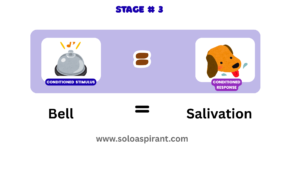
- Now, after the conditioning stage, the Dog starts salivating after ringing the bell.
- Here, the Bell is conditioned in place of food, and the behaviour of the dog is modified (Conditioned Response) towards the Bell.
Educational Implications of Classical Conditioning
- Develops habits of a learner
- Helpful of removal of Superstitions
- Helpful in adjustment
- Elimination of bad habits.
- Elimination of fear
- Formation of habits.
Conclusion of this Experiment
- Generalisation – The responses to Simalar Stimuli are also Similar.
- Discrimination – Learners learn to differentiate between to stimulis.
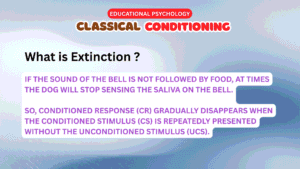
- Extinction – If the sound of the bell is not followed by food, then at times, comes when the dog will stop sensing the saliva to the bell.
Hi, I’m Amit Kumar — the author of SoloAspirant.
I am a content writer and tutor with a background in Physics and a B.Ed. Through this platform, I share study materials, notes, and PYQ PDFs curated to help aspirants prepare effectively for teaching and competitive exams.